
Powered
By possibility

Driven by need

Key unmet needs across the advanced or recurrent endometrial cancer (EC) treatment landscape highlight opportunities to power scientific progress for patients who have limited options.1-3
Flip each card to see how key unmet needs impact patients

Comorbidities and social determinants of health contribute to a heightened risk of advanced or recurrent EC in underserved populations.6,7,9

Discontinuation after 2L may reflect a need for better long-term outcomes and better efficacy from treatments.5

Metastatic disease is associated with greater molecular heterogeneity, which can contribute to resistance and poor treatment response.5,7,10,11
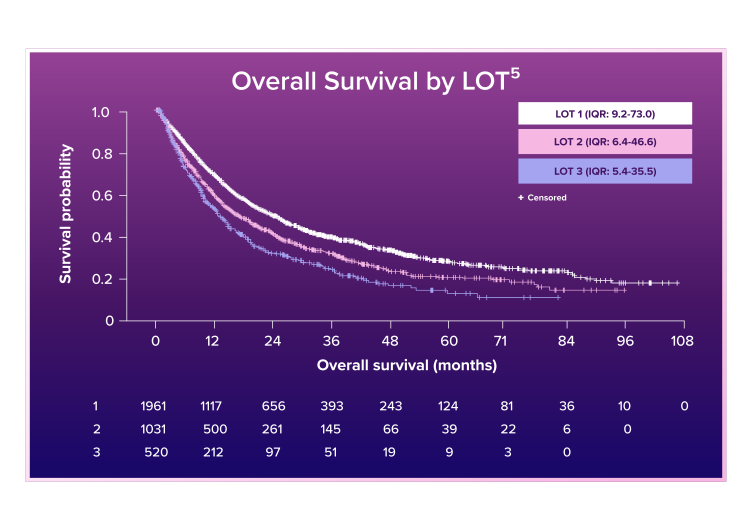
Survival decreases with each line of therapy (LOT) in advanced or recurrent EC5
Treatment patterns in advanced or recurrent endometrial cancer. Adapted from Coleman RL, Garside J, Hurteau J, Nguyen J, Kobayashi M. Treatment patterns and outcomes among patients with advanced or recurrent endometrial cancer initiating first-line therapy in the United States. J Health Econ Outcomes Res. 2023;10(2):82-90. Licensed under CC BY 4.0 (https://creativecommons.org/licenses/by/4.0/).
Overall survival was evaluated in a real-world study of 1961 patients with advanced or
recurrent EC who initiated at least 1 line of therapy.5




A cell-surface protein highly expressed across EC subtypes, regardless of histology or molecular classification.
- Trop-2 is linked to tumor cell growth, proliferation, invasion, metastasis, and survival through multiple pathways
- The consistent expression of Trop-2 has positioned it as a focus of ongoing clinical development

A transmembrane tyrosine kinase receptor that contributes to cell growth and survival through the MAPK and PI3K/AKT pathways.
- Treatment with HER2-directed therapies requires HER2 IHC testing
- In one study, HER2 overexpression was observed in approximately 60% of endometrial cancers (IHC 1+/2+/3+)

A cell-membrane protein often overexpressed in serous and epithelial endometrial tumors.
- It facilitates folate transport into cells, contributing to tumor growth and proliferation
- Endometrial tumors often show elevated levels of folate receptor alpha (FRa), with approximately 64% testing positive for FRa expression

A transmembrane protein that binds to a receptor on immune cells, allowing tumors to evade immune detection.
- B7-H4 is expressed in approximately 72% of endometrial cancers

1L=first line; 2L=second line; 3L=third line; AKT=protein kinase B; B7-H4=B7 homologue 4; EC=endometrial cancer; FRa=folate receptor alpha; HER2=human epidermal growth receptor 2; IHC=immunohistochemistry; IQR=interquartile range; LOT=line of therapy; MAPK=mitogen-activated protein kinase; PFS=progression-free survival; PI3K=phosphatidylinositol 3-kinase; Trop-2=trophoblast cell-surface antigen-2.
References
- Tillmanns T, Masri A, Stewart C, et al. Advanced endometrial cancer–the next generation of treatment: a Society of Gynecologic Oncology Journal Club clinical commentary. Gynecol Oncol Rep. 2024;55:101462. doi:10.1016/j.gore.2024.101462
- Scott B, Lorusso D. Advancements in endometrial cancer research in 2024. EMJ Oncol. 2025;13[Suppl1]:2-3. doi:10.33590/emjoncol/NINN2044
- Salmon A, Lebeau A, Streel S, et al. Locally advanced and metastatic endometrial cancer: current and emerging therapies. Cancer Treat Rev. 2024;129:102790. doi:10.1016/j.ctrv.2024.102790
- Vetter M, Powell MA. Evolving treatment landscape in endometrial cancer. healthbook TIMES Onco Hema. 2024;20(2):40-47. doi:10.36000/HBT.OH.2024.20.149
- Coleman RL, Garside J, Hurteau J, Nguyen J, Kobayashi M. Treatment patterns and outcomes among patients with advanced or recurrent endometrial cancer initiating first-line therapy in the United States. J Health Econ Outcomes Res. 2023;10(2):82-90. doi:10.36469/001c.87853
- Huang D, Li S, Bai Y, Wang Y. Efficacy and safety of immune checkpoint inhibitors for advanced or recurrent endometrial cancer: a systematic review and network meta-analysis. BMC Cancer. 2024;24(1):1298. doi:10.1186/s12885-024-13058-z
- Makker V, MacKay H, Ray-Coquard I, et al. Endometrial cancer. Nat Rev Dis Primers. 2021;7(1):88. doi:10.1038/s41572-021-00324‐8
- Buras AL, Mallen A, Wenham R, Montejo M. Stage IIIC endometrial cancer review: current controversies in adjuvant therapy. Gynecol Oncol Rep. 2021;36:100754. doi:10.1016/j.gore.2021.100754
- Fucinari J, Elshaikh MA, Ruterbusch JJ, et al. The impact of race, comorbid conditions, and obesity on survival endpoints in women with high grade endometrial carcinoma. Gynecol Oncol. 2021;162(1):134-141. doi:10.1016/j.ygyno.2021.04.036
- Sinai Borker N, Sajimon J, Subhadarshini S, et al. Role of intratumoral heterogeneity in metastatic progression and drug resistance. Discov Oncol. 2025;16(1):1689. doi:10.1007/s12672-025-03322-4
- Molefi T, Mabona L, Hull R, Sebitloane M, Dlamini Z. From genes to clinical practice: exploring the genomic underpinnings of endometrial cancer. Cancers. 2025;17(2):320. doi:10.3390/cancers17020320
- Shi X, Tang K, Zhang Q, et al. Antibody-drug conjugate combinations in cancer treatment: clinical efficacy and clinical study perspectives. Front Pharmacol. 2025;16:1556245. doi:10.3389/fphar.2025.1556245
- Fasih S, Welch S, Lohmann AE. Antibody-drug conjugates: a start of a new era in gynecological cancers. Curr Oncol. 2024;31(11):7088-7106. doi:10.3390/curroncol31110522
- Goldenberg DM, Stein R, Sharkey RM. The emergence of trophoblast cell-surface antigen 2 (TROP-2) as a novel cancer target. Oncotarget. 2018;9(48):28989-29006. doi:10.18632/oncotarget.25615
- Tong Y, Fan X, Liu H, Liang T. Advances in Trop-2 targeted antibody-drug conjugates for breast cancer: mechanisms, clinical applications, and future directions. Front Immunol. 2024;15:1495675. doi:10.3389/fimmu.2024.1495675
- Soberanis Pina P, Lheureux S. Novel molecular targets in endometrial cancer: mechanisms and perspectives for therapy. Biologics Targets Ther. 2024;18:79-93. doi:10.2147/BTT.S369783
- Hacker KE, Fleming KA, Gupta M, Pothuri B. HER2 expression in an endometrial cancer cohort. Gynecol Oncol. 2025;201:1-6. doi:10.1016/j.ygyno.2025.07.024
- Zhang J, Li Y, Wang L, Zhang Y, Zhang Q, Liu J. Folate receptor alpha promotes endometrial carcinoma cell proliferation and inhibits apoptosis by regulating the ERK signaling pathway. Int J Clin Exp Med. 2019;12(7):8791-8798.
- Phipps M, Falchook GS. B7 Homolog 4 (B7-H4)-directed agents in oncology clinical trials: a review. J Immunother Precis Oncol. 2025;8(2):153-160. doi:10.36401/JIPO-24-34
- Wang JY, Wang WP. B7-H4, a promising target for immunotherapy. Cell Immunol. 2020;347:104008. doi:10.1016/j.cellimm.2019.104008
- Zong L, Yu S, Mo S, et al. B7-H4 further stratifies patients with endometrial cancer exhibiting a nonspecific molecular profile. Arch Pathol Lab Med. 2023;147(11):1288-1297. doi:10.5858/arpa.2022-0182-OA
- Dai Y, Zhao L, Hua D, et al. Tumor immune microenvironment in endometrial cancer of different molecular subtypes: evidence from a retrospective observational study. Font Immunol. 2022;13:1035616. doi:10.3389/fimmu.2022.1035616
- Song S, Gu H, Li J, et al. Identification of immune-related gene signature for predicting prognosis in uterine corpus endometrial carcinoma. Sci Rep. 2023;13(1):9255. doi:10.1038/s41598-023-35655-x
- Alexa M, Hasenburg A, Battista MJ. The TCGA molecular classification of endometrial cancer and its possible impact on adjuvant treatment decisions. Cancers (Basel). 2021;13(6):1748. doi:10.3390/cancers13061478